**c/ua** ("koo-ah") is Docker for [Computer-Use Agents](https://www.oneusefulthing.org/p/when-you-give-a-claude-a-mouse) - it enables AI agents to control full operating systems in virtual containers and deploy them locally or to the cloud.
Check out more demos of the Computer-Use Agent in action
MCP Server: Work with Claude Desktop and Tableau
AI-Gradio: Multi-app workflow with browser, VS Code and terminal
Notebook: Fix GitHub issue in Cursor
# 🚀 Quick Start with a Computer-Use Agent UI
**Need to automate desktop tasks? Launch the Computer-Use Agent UI with a single command.**
### Option 1: Fully-managed install with Docker (recommended)
*Docker-based guided install for quick use*
**macOS/Linux/Windows (via WSL):**
```bash
# Requires Docker
/bin/bash -c "$(curl -fsSL https://raw.githubusercontent.com/trycua/cua/main/scripts/playground-docker.sh)"
```
This script will guide you through setup using Docker containers and launch the Computer-Use Agent UI.
---
### Option 2: [Dev Container](./.devcontainer/README.md)
*Best for contributors and development*
This repository includes a [Dev Container](./.devcontainer/README.md) configuration that simplifies setup to a few steps:
1. **Install the Dev Containers extension ([VS Code](https://marketplace.visualstudio.com/items?itemName=ms-vscode-remote.remote-containers) or [WindSurf](https://docs.windsurf.com/windsurf/advanced#dev-containers-beta))**
2. **Open the repository in the Dev Container:**
- Press `Ctrl+Shift+P` (or `⌘+Shift+P` on macOS)
- Select `Dev Containers: Clone Repository in Container Volume...` and paste the repository URL: `https://github.com/trycua/cua.git` (if not cloned) or `Dev Containers: Open Folder in Container...` (if git cloned).
> **Note**: On WindSurf, the post install hook might not run automatically. If so, run `/bin/bash .devcontainer/post-install.sh` manually.
3. **Open the VS Code workspace:** Once the post-install.sh is done running, open the `.vscode/py.code-workspace` workspace and press 
.
4. **Run the Agent UI example:** Click 
to start the Gradio UI. If prompted to install **debugpy (Python Debugger)** to enable remote debugging, select 'Yes' to proceed.
5. **Access the Gradio UI:** The Gradio UI will be available at `http://localhost:7860` and will automatically forward to your host machine.
---
### Option 3: PyPI
*Direct Python package installation*
```bash
# conda create -yn cua python==3.12
pip install -U "cua-computer[all]" "cua-agent[all]"
python -m agent.ui # Start the agent UI
```
Or check out the [Usage Guide](#-usage-guide) to learn how to use our Python SDK in your own code.
---
## Supported [Agent Loops](https://github.com/trycua/cua/blob/main/libs/python/agent/README.md#agent-loops)
- [UITARS-1.5](https://github.com/trycua/cua/blob/main/libs/python/agent/README.md#agent-loops) - Run locally on Apple Silicon with MLX, or use cloud providers
- [OpenAI CUA](https://github.com/trycua/cua/blob/main/libs/python/agent/README.md#agent-loops) - Use OpenAI's Computer-Use Preview model
- [Anthropic CUA](https://github.com/trycua/cua/blob/main/libs/python/agent/README.md#agent-loops) - Use Anthropic's Computer-Use capabilities
- [OmniParser-v2.0](https://github.com/trycua/cua/blob/main/libs/python/agent/README.md#agent-loops) - Control UI with [Set-of-Marks prompting](https://som-gpt4v.github.io/) using any vision model
## 🖥️ Compatibility
For detailed compatibility information including host OS support, VM emulation capabilities, and model provider compatibility, see the [Compatibility Matrix](./COMPATIBILITY.md).
# 🐍 Usage Guide
Follow these steps to use C/ua in your own Python code. See [Developer Guide](./docs/Developer-Guide.md) for building from source.
### Step 1: Install Lume CLI
```bash
/bin/bash -c "$(curl -fsSL https://raw.githubusercontent.com/trycua/cua/main/libs/lume/scripts/install.sh)"
```
Lume CLI manages high-performance macOS/Linux VMs with near-native speed on Apple Silicon.
### Step 2: Pull the macOS CUA Image
```bash
lume pull macos-sequoia-cua:latest
```
The macOS CUA image contains the default Mac apps and the Computer Server for easy automation.
### Step 3: Install Python SDK
```bash
pip install "cua-computer[all]" "cua-agent[all]"
```
### Step 4: Use in Your Code
```python
from computer import Computer
from agent import ComputerAgent, LLM
async def main():
# Start a local macOS VM
computer = Computer(os_type="macos")
await computer.run()
# Or with C/ua Cloud Container
computer = Computer(
os_type="linux",
api_key="your_cua_api_key_here",
name="your_container_name_here"
)
# Example: Direct control of a macOS VM with Computer
computer.interface.delay = 0.1 # Wait 0.1 seconds between kb/m actions
await computer.interface.left_click(100, 200)
await computer.interface.type_text("Hello, world!")
screenshot_bytes = await computer.interface.screenshot()
# Example: Create and run an agent locally using mlx-community/UI-TARS-1.5-7B-6bit
agent = ComputerAgent(
computer=computer,
loop="uitars",
model=LLM(provider="mlxvlm", name="mlx-community/UI-TARS-1.5-7B-6bit")
)
async for result in agent.run("Find the trycua/cua repository on GitHub and follow the quick start guide"):
print(result)
if __name__ == "__main__":
asyncio.run(main())
```
For ready-to-use examples, check out our [Notebooks](./notebooks/) collection.
### Lume CLI Reference
```bash
# Install Lume CLI and background service
curl -fsSL https://raw.githubusercontent.com/trycua/cua/main/libs/lume/scripts/install.sh | bash
# List all VMs
lume ls
# Pull a VM image
lume pull macos-sequoia-cua:latest
# Create a new VM
lume create my-vm --os macos --cpu 4 --memory 8GB --disk-size 50GB
# Run a VM (creates and starts if it doesn't exist)
lume run macos-sequoia-cua:latest
# Stop a VM
lume stop macos-sequoia-cua_latest
# Delete a VM
lume delete macos-sequoia-cua_latest
```
### Lumier CLI Reference
For advanced container-like virtualization, check out [Lumier](./libs/lumier/README.md) - a Docker interface for macOS and Linux VMs.
```bash
# Install Lume CLI and background service
curl -fsSL https://raw.githubusercontent.com/trycua/cua/main/libs/lume/scripts/install.sh | bash
# Run macOS in a Docker container
docker run -it --rm \
--name lumier-vm \
-p 8006:8006 \
-v $(pwd)/storage:/storage \
-v $(pwd)/shared:/shared \
-e VM_NAME=lumier-vm \
-e VERSION=ghcr.io/trycua/macos-sequoia-cua:latest \
-e CPU_CORES=4 \
-e RAM_SIZE=8192 \
-e HOST_STORAGE_PATH=$(pwd)/storage \
-e HOST_SHARED_PATH=$(pwd)/shared \
trycua/lumier:latest
```
## Resources
- [How to use the MCP Server with Claude Desktop or other MCP clients](./libs/python/mcp-server/README.md) - One of the easiest ways to get started with C/ua
- [How to use OpenAI Computer-Use, Anthropic, OmniParser, or UI-TARS for your Computer-Use Agent](./libs/python/agent/README.md)
- [How to use Lume CLI for managing desktops](./libs/lume/README.md)
- [Training Computer-Use Models: Collecting Human Trajectories with C/ua (Part 1)](https://www.trycua.com/blog/training-computer-use-models-trajectories-1)
- [Build Your Own Operator on macOS (Part 1)](https://www.trycua.com/blog/build-your-own-operator-on-macos-1)
## Modules
| Module | Description | Installation |
|--------|-------------|---------------|
| [**Lume**](./libs/lume/README.md) | VM management for macOS/Linux using Apple's Virtualization.Framework | `curl -fsSL https://raw.githubusercontent.com/trycua/cua/main/libs/lume/scripts/install.sh \| bash` |
| [**Lumier**](./libs/lumier/README.md) | Docker interface for macOS and Linux VMs | `docker pull trycua/lumier:latest` |
| [**Computer (Python)**](./libs/python/computer/README.md) | Python Interface for controlling virtual machines | `pip install "cua-computer[all]"` |
| [**Computer (Typescript)**](./libs/typescript/computer/README.md) | Typescript Interface for controlling virtual machines | `npm install @trycua/computer` |
| [**Agent**](./libs/python/agent/README.md) | AI agent framework for automating tasks | `pip install "cua-agent[all]"` |
| [**MCP Server**](./libs/python/mcp-server/README.md) | MCP server for using CUA with Claude Desktop | `pip install cua-mcp-server` |
| [**SOM**](./libs/python/som/README.md) | Self-of-Mark library for Agent | `pip install cua-som` |
| [**Computer Server**](./libs/python/computer-server/README.md) | Server component for Computer | `pip install cua-computer-server` |
| [**Core (Python)**](./libs/python/core/README.md) | Python Core utilities | `pip install cua-core` |
| [**Core (Typescript)**](./libs/typescript/core/README.md) | Typescript Core utilities | `npm install @trycua/core` |
## Computer Interface Reference
For complete examples, see [computer_examples.py](./examples/computer_examples.py) or [computer_nb.ipynb](./notebooks/computer_nb.ipynb)
```python
# Shell Actions
result = await computer.interface.run_command(cmd) # Run shell command
# result.stdout, result.stderr, result.returncode
# Mouse Actions
await computer.interface.left_click(x, y) # Left click at coordinates
await computer.interface.right_click(x, y) # Right click at coordinates
await computer.interface.double_click(x, y) # Double click at coordinates
await computer.interface.move_cursor(x, y) # Move cursor to coordinates
await computer.interface.drag_to(x, y, duration) # Drag to coordinates
await computer.interface.get_cursor_position() # Get current cursor position
await computer.interface.mouse_down(x, y, button="left") # Press and hold a mouse button
await computer.interface.mouse_up(x, y, button="left") # Release a mouse button
# Keyboard Actions
await computer.interface.type_text("Hello") # Type text
await computer.interface.press_key("enter") # Press a single key
await computer.interface.hotkey("command", "c") # Press key combination
await computer.interface.key_down("command") # Press and hold a key
await computer.interface.key_up("command") # Release a key
# Scrolling Actions
await computer.interface.scroll(x, y) # Scroll the mouse wheel
await computer.interface.scroll_down(clicks) # Scroll down
await computer.interface.scroll_up(clicks) # Scroll up
# Screen Actions
await computer.interface.screenshot() # Take a screenshot
await computer.interface.get_screen_size() # Get screen dimensions
# Clipboard Actions
await computer.interface.set_clipboard(text) # Set clipboard content
await computer.interface.copy_to_clipboard() # Get clipboard content
# File System Operations
await computer.interface.file_exists(path) # Check if file exists
await computer.interface.directory_exists(path) # Check if directory exists
await computer.interface.read_text(path, encoding="utf-8") # Read file content
await computer.interface.write_text(path, content, encoding="utf-8") # Write file content
await computer.interface.read_bytes(path) # Read file content as bytes
await computer.interface.write_bytes(path, content) # Write file content as bytes
await computer.interface.delete_file(path) # Delete file
await computer.interface.create_dir(path) # Create directory
await computer.interface.delete_dir(path) # Delete directory
await computer.interface.list_dir(path) # List directory contents
# Accessibility
await computer.interface.get_accessibility_tree() # Get accessibility tree
# Delay Configuration
# Set default delay between all actions (in seconds)
computer.interface.delay = 0.5 # 500ms delay between actions
# Or specify delay for individual actions
await computer.interface.left_click(x, y, delay=1.0) # 1 second delay after click
await computer.interface.type_text("Hello", delay=0.2) # 200ms delay after typing
await computer.interface.press_key("enter", delay=0.5) # 500ms delay after key press
# Python Virtual Environment Operations
await computer.venv_install("demo_venv", ["requests", "macos-pyxa"]) # Install packages in a virtual environment
await computer.venv_cmd("demo_venv", "python -c 'import requests; print(requests.get(`https://httpbin.org/ip`).json())'") # Run a shell command in a virtual environment
await computer.venv_exec("demo_venv", python_function_or_code, *args, **kwargs) # Run a Python function in a virtual environment and return the result / raise an exception
# Example: Use sandboxed functions to execute code in a C/ua Container
from computer.helpers import sandboxed
@sandboxed("demo_venv")
def greet_and_print(name):
"""Get the HTML of the current Safari tab"""
import PyXA
safari = PyXA.Application("Safari")
html = safari.current_document.source()
print(f"Hello from inside the container, {name}!")
return {"greeted": name, "safari_html": html}
# When a @sandboxed function is called, it will execute in the container
result = await greet_and_print("C/ua")
# Result: {"greeted": "C/ua", "safari_html": "..."}
# stdout and stderr are also captured and printed / raised
print("Result from sandboxed function:", result)
```
## ComputerAgent Reference
For complete examples, see [agent_examples.py](./examples/agent_examples.py) or [agent_nb.ipynb](./notebooks/agent_nb.ipynb)
```python
# Import necessary components
from agent import ComputerAgent, LLM, AgentLoop, LLMProvider
# UI-TARS-1.5 agent for local execution with MLX
ComputerAgent(loop=AgentLoop.UITARS, model=LLM(provider=LLMProvider.MLXVLM, name="mlx-community/UI-TARS-1.5-7B-6bit"))
# OpenAI Computer-Use agent using OPENAI_API_KEY
ComputerAgent(loop=AgentLoop.OPENAI, model=LLM(provider=LLMProvider.OPENAI, name="computer-use-preview"))
# Anthropic Claude agent using ANTHROPIC_API_KEY
ComputerAgent(loop=AgentLoop.ANTHROPIC, model=LLM(provider=LLMProvider.ANTHROPIC))
# OmniParser loop for UI control using Set-of-Marks (SOM) prompting and any vision LLM
ComputerAgent(loop=AgentLoop.OMNI, model=LLM(provider=LLMProvider.OLLAMA, name="gemma3:12b-it-q4_K_M"))
# OpenRouter example using OAICOMPAT provider
ComputerAgent(
loop=AgentLoop.OMNI,
model=LLM(
provider=LLMProvider.OAICOMPAT,
name="openai/gpt-4o-mini",
provider_base_url="https://openrouter.ai/api/v1"
),
api_key="your-openrouter-api-key"
)
```
## Community
Join our [Discord community](https://discord.com/invite/mVnXXpdE85) to discuss ideas, get assistance, or share your demos!
## License
Cua is open-sourced under the MIT License - see the [LICENSE](LICENSE) file for details.
Microsoft's OmniParser, which is used in this project, is licensed under the Creative Commons Attribution 4.0 International License (CC-BY-4.0) - see the [OmniParser LICENSE](https://github.com/microsoft/OmniParser/blob/master/LICENSE) file for details.
## Contributing
We welcome contributions to CUA! Please refer to our [Contributing Guidelines](CONTRIBUTING.md) for details.
## Trademarks
Apple, macOS, and Apple Silicon are trademarks of Apple Inc. Ubuntu and Canonical are registered trademarks of Canonical Ltd. Microsoft is a registered trademark of Microsoft Corporation. This project is not affiliated with, endorsed by, or sponsored by Apple Inc., Canonical Ltd., or Microsoft Corporation.
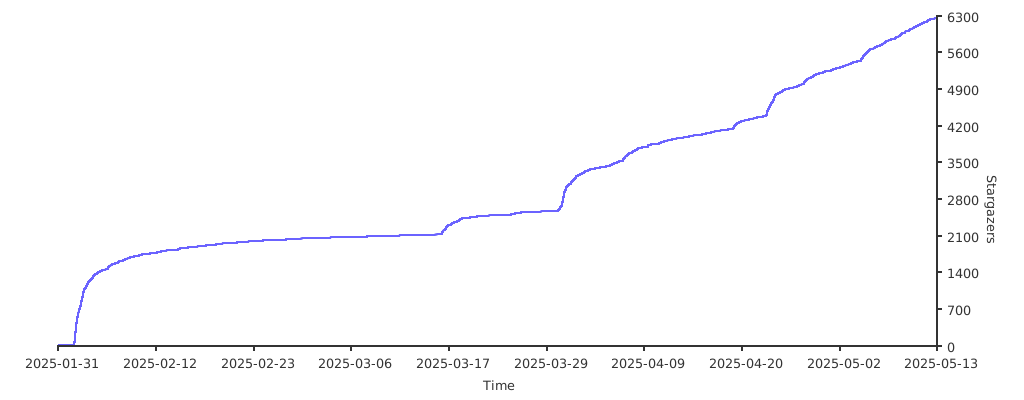
## Stargazers
Thank you to all our supporters!
[](https://starchart.cc/trycua/cua)
## Contributors


