
Graph
The graph service provides the Graph API which is a RESTful web API used to access Infinite Scale resources. It is inspired by the Microsoft Graph API and can be used by clients or other services or extensions.
Manual Filters
Using the API, you can manually filter like for users. See the Libre Graph API for examples in the developer documentation. Note that you can use and and or to refine results.
Sequence Diagram
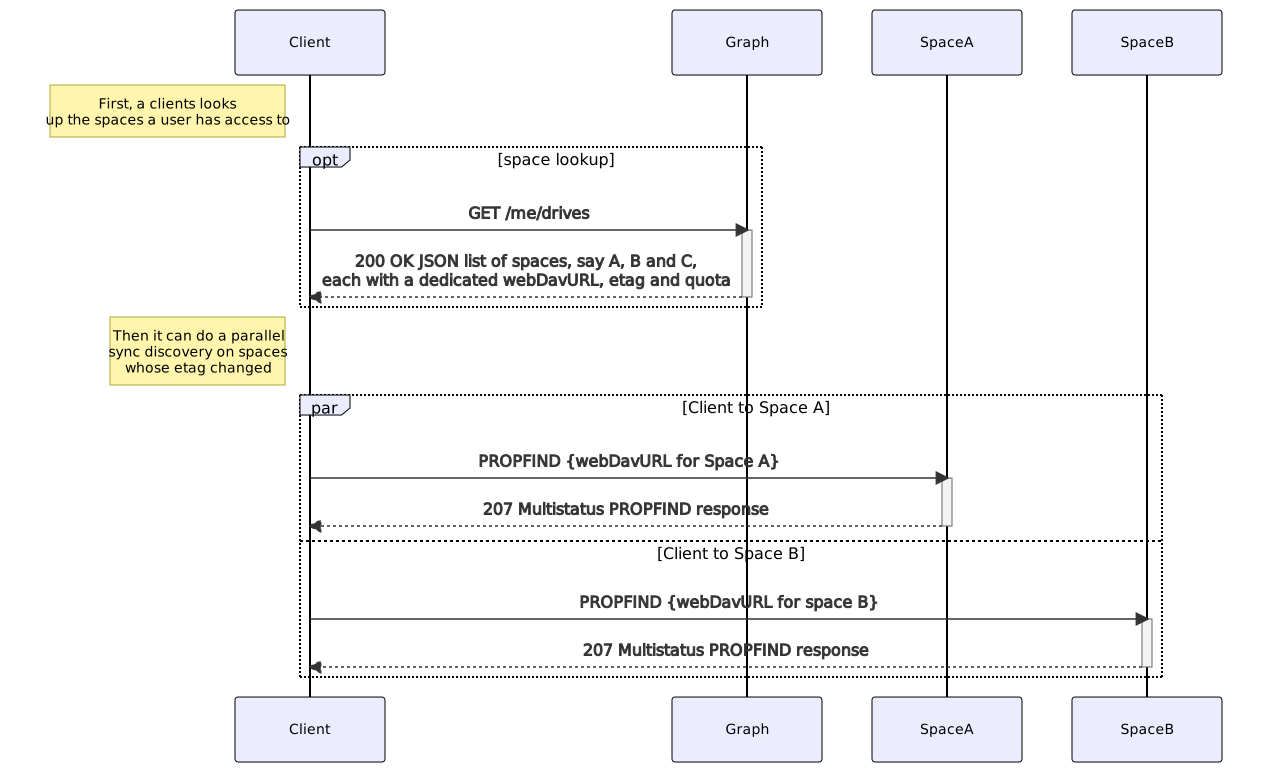
The following image gives an overview of the scenario when a client requests to list available spaces the user has access to. To do so, the client is directed with his request automatically via the proxy service to the graph service.
Caching
The graph service can use a configured store via GRAPH_CACHE_STORE. Possible stores are:
memory: Basic in-memory store and the default.redis-sentinel: Stores data in a configured Redis Sentinel cluster.nats-js-kv: Stores data using key-value-store feature of nats jetstreamnoop: Stores nothing. Useful for testing. Not recommended in production environments.ocmem: Advanced in-memory store allowing max size. (deprecated)redis: Stores data in a configured Redis cluster. (deprecated)etcd: Stores data in a configured etcd cluster. (deprecated)nats-js: Stores data using object-store feature of nats jetstream (deprecated)
Other store types may work but are not supported currently.
Note: The service can only be scaled if not using memory store and the stores are configured identically over all instances!
Note that if you have used one of the deprecated stores, you should reconfigure to one of the supported ones as the deprecated stores will be removed in a later version.
Store specific notes:
- When using
redis-sentinel, the Redis master to use is configured via e.g.OCIS_CACHE_STORE_NODESin the form of<sentinel-host>:<sentinel-port>/<redis-master>like10.10.0.200:26379/mymaster. - When using
nats-js-kvit is recommended to setOCIS_CACHE_STORE_NODESto the same value asOCIS_EVENTS_ENDPOINT. That way the cache uses the same nats instance as the event bus. - When using the
nats-js-kvstore, it is possible to setOCIS_CACHE_DISABLE_PERSISTENCEto instruct nats to not persist cache data on disc.
Keycloak Configuration For The Personal Data Export
If Keycloak is used for authentication, GDPR regulations require to add all personal identifiable information that Keycloak has about the user to the personal data export. To do this, the following environment variables must be set:
OCIS_KEYCLOAK_BASE_PATH- The URL to the keycloak instance.OCIS_KEYCLOAK_CLIENT_ID- The client ID of the client that is used to authenticate with keycloak, this client has to be able to list users and get the credential data.OCIS_KEYCLOAK_CLIENT_SECRET- The client secret of the client that is used to authenticate with keycloak.OCIS_KEYCLOAK_CLIENT_REALM- The realm the client is defined in.OCIS_KEYCLOAK_USER_REALM- The realm the oCIS users are defined in.OCIS_KEYCLOAK_INSECURE_SKIP_VERIFY- If set to true, the TLS certificate of the keycloak instance is not verified.
For more details see the User-Triggered GDPR Report in the ocis admin documentation.
Keycloak Client Configuration
The client that is used to authenticate with keycloak has to be able to list users and get the credential data. To do this, the following roles have to be assigned to the client and they have to be about the realm that contains the oCIS users:
view-usersview-identity-providersview-realmview-clientsview-eventsview-authorization
Note that these roles are only available to assign if the client is in the master realm.
Translations
The graph service has embedded translations sourced via transifex to provide a basic set of translated languages. These embedded translations are available for all deployment scenarios. In addition, the service supports custom translations, though it is currently not possible to just add custom translations to embedded ones. If custom translations are configured, the embedded ones are not used. To configure custom translations, the GRAPH_TRANSLATION_PATH environment variable needs to point to a base folder that will contain the translation files. This path must be available from all instances of the graph service, a shared storage is recommended. Translation files must be of type .po or .mo. For each language, the filename needs to be graph.po (or graph.mo) and stored in a folder structure defining the language code. In general the path/name pattern for a translation file needs to be:
{GRAPH_TRANSLATION_PATH}/{language-code}/LC_MESSAGES/graph.po
The language code pattern is composed of language[_territory] where language is the base language and _territory is optional and defines a country.
For example, for the language de, one needs to place the corresponding translation files to {GRAPH_TRANSLATION_PATH}/de_DE/LC_MESSAGES/graph.po.
Important: For the time being, the embedded ownCloud Web frontend only supports the main language code but does not handle any territory. When strings are available in the language code language_territory, the web frontend does not see it as it only requests language. In consequence, any translations made must exist in the requested language to avoid a fallback to the default.
Translation Rules
- If a requested language code is not available, the service tries to fall back to the base language if available. For example, if the requested language-code
de_DEis not available, the service tries to fall back to translations in thedefolder. - If the base language
deis also not available, the service falls back to the system's default English (en), which is the source of the texts provided by the code.
Default Language
The default language can be defined via the OCIS_DEFAULT_LANGUAGE environment variable. See the settings service for a detailed description.
Unified Role Management
Unified Roles are roles granted a user for sharing and can be enabled or disabled. A CLI command is provided to list existing roles and their state among other data.
{{< hint info >}} Note that a disabled role does not lose previously assigned permissions. It only means that the role is not available for new assignments. {{< /hint >}}
The following roles are enabled by default:
UnifiedRoleViewerIDUnifiedRoleSpaceViewerUnifiedRoleEditorUnifiedRoleSpaceEditorUnifiedRoleFileEditorUnifiedRoleEditorLiteUnifiedRoleManager
The following role is disabled by default:
UnifiedRoleSecureViewer
To enable disabled roles like the UnifiedRoleSecureViewer, you must provide the UID(s) by one of the following methods:
- Using the
GRAPH_AVAILABLE_ROLESenvironment variable. - Setting the
available_rolesconfiguration value.
The following CLI command simplifies the process of finding out which UID belongs to which role:
ocis graph list-unified-roles
The output of this command includes the following information for each role:
UID
The unique identifier of the role.Enabled
Whether the role is enabled or not.Description
A short description of the role.ConditionAllowed resource actions
Example output (shortned)
+--------------------------------------+----------+--------------------------------+--------------------------------+------------------------------------------+
|                 UID                  | ENABLED  |          DESCRIPTION           |           CONDITION            |         ALLOWED RESOURCE ACTIONS         |
+--------------------------------------+----------+--------------------------------+--------------------------------+------------------------------------------+
| a8d5fe5e-96e3-418d-825b-534dbdf22b99 | enabled  | View and download.             | exists @Resource.Root          | libre.graph/driveItem/path/read          |
|                                      |          |                                |                                | libre.graph/driveItem/quota/read         |
|                                      |          |                                |                                | libre.graph/driveItem/content/read       |
|                                      |          |                                |                                | libre.graph/driveItem/permissions/read   |
|                                      |          |                                |                                | libre.graph/driveItem/children/read      |
|                                      |          |                                |                                | libre.graph/driveItem/deleted/read       |
|                                      |          |                                |                                | libre.graph/driveItem/basic/read         |
+--------------------------------------+----------+--------------------------------+--------------------------------+------------------------------------------+